


The Nigeria Customs Service (NCS) has expressed a strong commitment to fast-tracking Nigeria’s integration into global trade systems through the adoption of international trade facilitation standards developed by the United Nations Centre for Trade Facilitation and Electronic Business (UN/CEFACT).
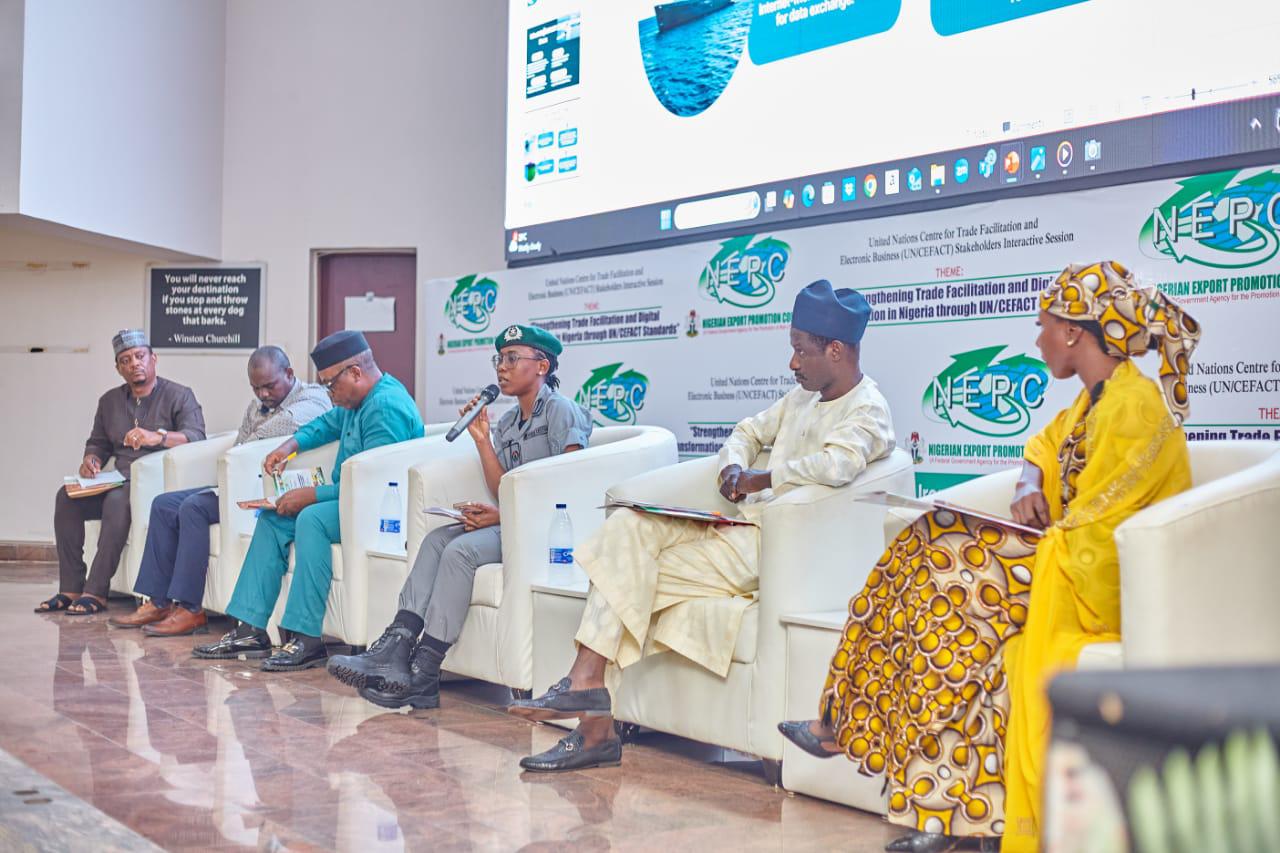
This assurance was given during a high-level stakeholders’ interactive session organised recently by the Nigerian Export Promotion Council (NEPC), themed “Strengthening Trade Facilitation and Digital Transformation in Nigeria through UN/CEFACT Standards”.
The session, held at the NEPC headquarters in Abuja, brought together key players from the public and private sectors to deliberate on aligning Nigeria’s trade ecosystem with global best practices.
UN/CEFACT, a subsidiary intergovernmental body of the United Nations Economic Commission for Europe (UNECE), is tasked with simplifying and harmonising international trade procedures.
It develops globally accepted standards and recommendations for electronic business and regulatory cooperation to enhance efficiency in cross-border transactions.
Nigeria Customs Service was represented on the occasion by the Assistant Comptroller of Customs Mary-Ann Egwunyega., Assistant Comptroller of Customs Nnamdi Digwo, and Chief Superintendent of Customs Miriam Ogalu.
They underscored the pivotal role of Customs in advancing the country’s trade facilitation agenda. Assistant Comptroller Mary-Ann Egwunyega explained that the NCS is actively implementing several trade-enabling initiatives in line with UN/CEFACT standards.
These include the Advance Ruling system, which supports predictability in the classification, valuation, and origin of goods; the Authorised Economic Operator (AEO) programme, comprising the AEO Simplified and AEO Safety & Security schemes; and the indigenous B’Odogwu system, a digital innovation aimed at improving integration and collaboration in port operations.
“Our alignment with UN/CEFACT is strategic. These tools reduce time and cost for compliant traders, strengthen transparency, and help position Nigeria as a serious player in the global trade ecosystem,” she said.