





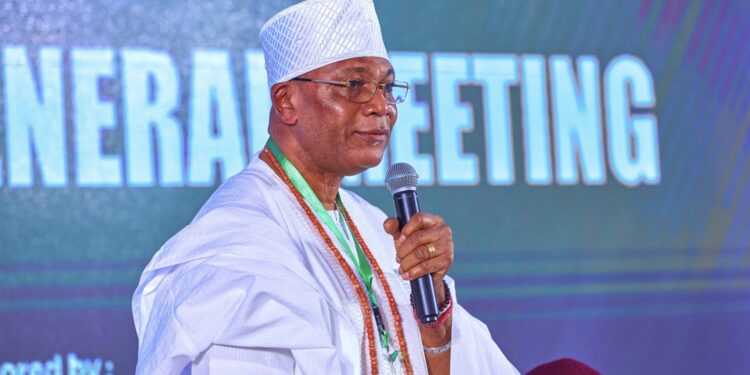
Photo: Francis Meshioye, MAN President
Highlights of Manufacturing Status in 2025

In 2025, the operators in Nigeria’s manufacturing sector encountered ten major obstacles, according to the Manufacturers Association of Nigeria (MAN).
In a highlight of the year under review, the most prominent issues were inadequate power supply, high exchange rates/forex shortages, and low government procurement of domestically produced goods.
Additional recurrent challenges included the high cost and scarcity of raw materials, elevated interest rates, limited access to credit, poor road infrastructure, and high logistics costs.
Other significant hurdles were multiple taxation, overregulation by the government, policy inconsistencies, and heavy import duties.
MAN said that in the year in review, the industry was also impacted by a resurgence of insecurity in critical agricultural and industrial zones, which hampered local raw material sourcing.
Of Nigeria’s 14 industrial zones, activity levels in Abuja declined to 36.7% from 39.5%; Bauchi/Benue and Plateau dropped from 36.2% to 35.8%, while Kwara/Kogi decreased from 57.8% to 52.6%.

Manufacturers’ outlook for 2026
Given the above macroeconomic environment, (MAN), as part of its policy advocacy to improve the sector performance in 2026, called on the monetary authorities, the Central Bank of Nigeria, and the Federal Ministry of Finance , to introduce a Manufacturing Refinancing and Rediscounting Facility (MRRF), asserting that it can reinvigorate the manufacturing sector in 2026.
Preparing its members for a positive outlook in 2026, MAN also advocates for the establishment of a Manufacturers Bank offering long-term concessionary credit.
Making the call, the Director -General of MAN, Segun Ajayi-Kadir, emphasised that the MRRF is to enable banks to refinance approved manufacturing loans at single-digit rates for up to seven years.
He noted that to ensure a more robust manufacturing sector in 2026, there was also a need to:
1. Create a publicly accessible dashboard tracking lending flows, interest rate spreads, loan approvals and sectoral disbursement patterns in real time.
2. Further reduce the benchmark interest rate by at least 200–300 basis points over the next two quarters to make credit affordable for manufacturers.
3. Craft and ensure the effective execution of the implementation strategy for the recently approved Nigeria Industrial Policy.
4. Categorise manufacturers as strategic users of gas to remove the gap between what manufacturers and electricity generation companies pay per cubic foot of gas.
5. Introduce a stable, transparent gas pricing framework for manufacturers and prioritise local gas supply before exports.
Top Recommendations
FGN should appoint Economic/Commercial Attachés in countries with significant Nigerian trade and investment interests to strengthen market intelligence and export promotions.
FGN should mainstream the reports of MAN Summit, Blueprint 2.0 and 2025 Think Tank into the Nigeria Industrial Policy and adopted as working documents for Industrial revolution.
MAN should utilise the MEAL dashboard, sector KPIs and structured feedback loops to track reform performance.
MAN should be accorded a preeminent role in national power policy and granted membership of NEC and NERC.
The MAN EPC should institutionalise bi-annual meetings where EPC in conjunction with experts will have deep-dive session on sectoral and policy issues.
FGN should establish a dedicated joint security task force to safeguard industrial zones nationwide.