





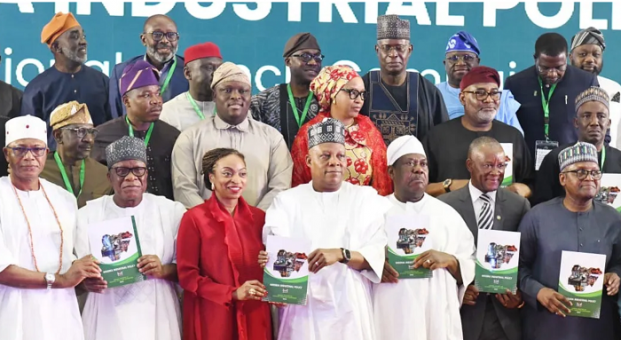
In Picture from Right: Aliko Dangote; John Eno Minister of State for Industry; Vice President Kashim Shettima; Jumoke oduwole, Minister of Industry; Francis Meshioye, President of the Manufacturers Association of Nigeria, among other top dignitaries …
The Federal Government of Nigeria has relaunched it’s National Industrial Policy 2025 in Abuja, themed “From Policy to Productivity: Implementing Nigeria’s Industrial Future.
Launched by the Vice President, Kashim Shettima on behalf of President Bola Tinubu, on Tuesday 17 February, 2025, private sector representatives at the launch welcomed the initiative, describing it as a step toward policy clarity and macroeconomic stability, while reiterating the need for a reliable power supply and sustained protection for domestic industries.
Here are the key highlights of the new Industrial Policy 2025, according to Vice President Shettima :
- It is a comprehensive economic framework aimed at ending the country’s long-standing dependence on raw material exports and repositioning the economy for domestic manufacturing and value addition.
2. The new Policy is a deliberate shift from past industrial strategies that failed to translate into measurable economic transformation.
3. The policy aims to fulfils a central commitment of President Tinubu’s administration to move Nigeria from a commodity-export model to a production-driven economy capable of generating jobs, strengthening value chains and improving global competitiveness.
4. The framework is designed as an implementable roadmap rather than an aspirational document, with a focus on rebuilding Nigeria’s industrial base and embedding job creation at the centre of economic planning.
5. At its core, the policy seeks to restructure how Nigeria utilises its natural and agricultural resources. For decades, the country has exported crude and primary commodities while importing finished goods at significantly higher costs, a pattern economists said drains value from the domestic economy and weakens industrial growth.
6. The new policy framework prioritises sectors where Nigeria has comparative advantages, including agro-processing, textiles and garments, petrochemicals, pharmaceuticals, metals, light manufacturing and technology-enabled industries.
7. Minister of State for Industry, John Owan Enoh, cited recent developments in the shea value chain as evidence of the impact of targeted industrial measures.
He noted that restrictions on the export of raw shea nuts led to a rapid expansion of domestic processing capacity, higher incomes for farmers and increased exports of processed shea products within a year.
8. The policy is also intended to address structural constraints that have historically undermined manufacturing, including unreliable electricity supply, weak infrastructure, limited access to financing, skills gaps and regulatory uncertainty.
9. Rather than treating the challenges in isolation, the framework integrates energy, logistics, finance, skills development and trade into a coordinated strategy with defined institutional responsibilities and measurable performance indicators.
10. Micro, small and medium enterprises are positioned as central drivers of industrial growth under the framework, reversing a history in which many small producers operated outside formal industrial planning despite forming the backbone of local production.
11. Beyond domestic goals, the policy aligns with Nigeria’s ambitions under the African Continental Free Trade Area (AfCFTA), positioning the country as a manufacturing hub for West Africa and the wider continent.
12. Government officials acknowledged Nigeria’s record of ambitious but poorly executed industrial programmes and stressed that the new framework places heavy emphasis on monitoring and accountability.
13. Clear performance targets and implementation oversight mechanisms are intended to ensure that policy commitments translate into economic outcomes.
14. With the rollout of the policy, the government signalled that implementation would begin immediately, framing industrialisation as a shared responsibility between government and industry.