








By Staff Reporter
The Manufacturers Association of Nigeria (MAN) has unveiled a 10-point policy intervention plan aimed at reversing the country’s declining industrial fortunes, reducing import dependency and stimulating sustainable growth in the manufacturing sector.
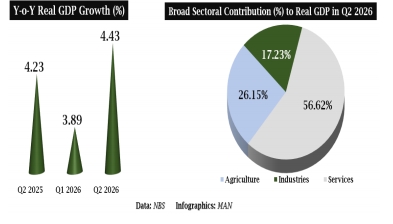
The proposals came against the backdrop of the latest Gross Domestic Product (GDP) report by the National Bureau of Statistics (NBS), which showed that Nigeria’s economy grew by 4.43 per cent year-on-year in the second quarter of 2026, compared with 3.89 per cent in the first quarter and 4.23 per cent in Q2 2025.
While acknowledging the headline growth as a sign of macroeconomic resilience, MAN said the figures masked growing weaknesses in the productive sectors of the economy.
Director-General of MAN, Segun Ajayi-Kadir, said the latest GDP figures revealed a widening disconnect between overall economic growth and the performance of the real sector.
According to him, services accounted for 56.62 per cent of GDP, while the broader industrial sector contributed only 17.23 per cent and continued to face severe structural constraints.
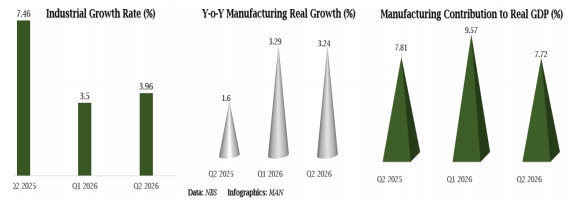
Chart credit: MAN
He said industrial growth had almost halved from 7.46 per cent in Q2 2025 to 3.96 per cent in Q2 2026.“The growth trajectory remains disproportionately service-driven, while the broader industrial sector is visibly suffocating under severe structural headwinds,” Ajayi-Kadir said.
He identified the power sector as a major drag on industrial performance, noting that Electricity, Gas, Steam and Air Conditioning Supply recorded a 10.63 per cent contraction during the quarter.Manufacturing performance also remained weak.
The sector’s share of real GDP fell from 9.57 per cent in Q1 2026 to 7.72 per cent in Q2, while its real growth rate declined marginally from 3.29 per cent to 3.24 per cent.
MAN warned that continued dependence on services and extractive activities would not provide the foundation required for sustainable industrialisation, export growth, foreign-exchange accumulation and mass employment.
“Therefore, Nigeria cannot sustain its growth momentum on services and extraction alone. A nation that trades and consumes what it does not produce builds prosperity on quicksand,” the MAN DG said.
To address the crisis, here are the 10 proposals of MAN’s recommendations:
- Industrial Energy Security and Grid Optimisation
Direct NERC to approve Eligible Customer status for contiguous industrial clusters, allowing manufacturers to enter direct bulk Power Purchase Agreements (PPAs) with GenCos and reduce dependence on DisCos.
2. Matching Grants for Captive Renewable Energy
Establish a matching-grant facility through the Bank of Industry to support manufacturers investing in captive solar PV and battery-storage systems.
3.Manufacturing Credit Guarantee Scheme
Create a dedicated credit-guarantee scheme through MOFI and DBN to de-risk commercial-bank lending to manufacturers and help reduce interest rates.
4. Priority FX Window for Manufacturers
Establish a transparent, prioritised FX clearance window within the official market for the importation of raw materials and capital machinery backed by Letters of Credit (LCs).
5. Legal Backing for Nigeria Industrial Policy 2025
Pass the Nigeria Industrial Policy 2025 as an Act of Parliament, making its targets and incentives legally binding and protecting them from arbitrary policy reversals.
6. 60% Local Procurement Target for Government
Integrate the Bureau of Public Procurement portal with a local-content registry and block budget releases to MDAs that fail to meet a 60% local-procurement target.
7. Local Patronage and Right of First Refusal
Enact a Local Patronage Compliance Act requiring MDAs to give Nigerian manufacturers the right of first refusal, with a Certificate of Non-Availability required before foreign purchases.
8. Automotive Industry Protection and Tax Relief
Enforce the 10-year tax relief for local vehicle assembly under the NAIDP while imposing punitive import surcharges on fully built imported vehicles.
9. Farm-to-Factory Tax Incentives
Apply zero-rated VAT and early-stage tax exemptions to traceable domestic farm-to-factory supply chains to reduce the cost of locally sourced manufacturing inputs.
10. Import Thresholds and Local Manufacturing Transition
Set annual thresholds for imported goods where domestic capacity is limited, giving investors three years to establish local assembly and a further two years to transition to full-scale manufacturing.