







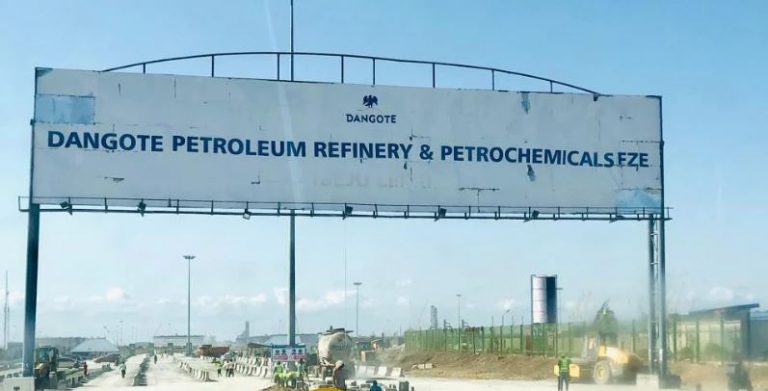
A fresh legal battle between Dangote Petroleum Refinery and the Nigerian Midstream and Downstream Petroleum Regulatory Authority (NMDPRA) has raised fundamental questions over the extent of petroleum regulation within Nigeria’s free trade zones.
A Federal High Court in Lagos has restrained the NMDPRA from enforcing its directive suspending the loading and truck-out of petroleum products from the Dangote Petroleum Refinery at the Lekki Free Zone.
Justice Akintayo Aluko, ruling on an ex-parte application on Monday, also barred the petroleum regulator, its officers, agents and representatives from entering, sealing, shutting down, restricting access to, obstructing, suspending, disrupting, inspecting, supervising, sanctioning or otherwise interfering with the refinery’s operations within the Lekki Free Zone pending the determination of the substantive application.
The order followed an application filed by Dangote Petroleum Refinery and Petrochemicals FZE in Suit No. FHC/L/CS/1174/2026.At the centre of the dispute is an August 24, 2026 directive issued by NMDPRA suspending the loading and truck-out of petroleum products from the refinery.
The refinery is challenging the directive on the ground that the petroleum regulator lacks the statutory authority to exercise regulatory or oversight powers over its operations within the free zone.
The case therefore goes beyond the immediate suspension of product evacuation.
It raises a broader question about the intersection between Nigeria’s petroleum regulatory framework and the legal regime governing free zones.
A Question of Regulatory Jurisdiction
In granting the interim injunction, Justice Aluko said the materials before the court disclosed serious issues requiring judicial determination, particularly whether NMDPRA possesses regulatory or oversight powers over operations conducted within free zones.
Dangote’s position, according to the court, is that NMDPRA does not have regulatory powers capable of affecting operations within free zones, including the Dangote Industrial Free Zone.
The judge also drew attention to a March 2, 2026 letter from the Attorney-General of the Federation which, according to the ruling, “clearly stated” that NMDPRA was not entitled to exercise regulatory powers or oversight functions over operations within free zones.
That position appears to be at odds with the August 24 directive through which NMDPRA sought to restrict the refinery’s product-loading activities.
The resulting legal question is whether the regulator can continue exercising such authority while the court is yet to determine the substantive dispute.
Justice Aluko said the court was particularly concerned with preserving the subject matter of the litigation until the substantive issues could be fully heard.
“What the plaintiff has asked this court to do is to preserve the res pending the determination of the motion on notice,” the judge said.
If the court ultimately upholds Dangote’s interpretation of the free-zone regime, it could place important limits on the manner in which petroleum-sector regulators exercise their powers within designated free zones.
Why the Order Matters
The interim order temporarily shifts the balance in the regulatory dispute.
Dangote Refinery is one of the most significant new assets in Nigeria’s downstream petroleum sector, and any restriction on its ability to load and evacuate products has implications beyond the company itself, potentially affecting fuel supply, distribution and the wider downstream market.
For NMDPRA, however, the dispute touches on the scope of its statutory responsibilities as the regulator of Nigeria’s midstream and downstream petroleum industry.
The substantive hearing will therefore be important not only to Dangote Refinery but also to other businesses operating petroleum-related activities within Nigeria’s free zones.
If the court ultimately upholds Dangote’s interpretation of the free-zone regime, it could place important limits on the manner in which petroleum-sector regulators exercise their powers within designated free zones.
Conversely, a ruling affirming NMDPRA’s jurisdiction could strengthen the regulator’s authority to supervise petroleum activities even where such operations are located within a free-zone framework.
Court Seeks to Preserve Status Quo
The judge said Dangote had satisfied the legal requirements for the grant of an interim injunction, noting that the affidavit evidence disclosed serious issues that required urgent judicial intervention.
“The law is settled on the conditions which an applicant must satisfy to be entitled to an order of interim injunction,” Aluko held, adding that the conditions had been satisfied in the case.
The court also considered Dangote’s undertaking to indemnify NMDPRA in damages if it is subsequently established that the interim order should not have been granted.Justice Aluko consequently granted the application and directed Dangote to file a formal undertaking as to damages.
The interim order and notice of the court are to be served on NMDPRA.
The regulator is consequently barred, for now, from implementing its August 24 directive or taking the enforcement measures specified in the order against the refinery.Dangote’s legal team was led by Senior Advocates of Nigeria Olawale Akoni and Abimbola Akeredolu.
In moving the application, Akeredolu relied on a 42-paragraph affidavit deposed to by Wale Aroge, a written address and documentary exhibits marked A1 to A6.
The court adjourned the matter until September 9, 2026, for hearing of the motion on notice.
The eventual ruling on the substantive issues could provide a significant judicial interpretation of the relationship between Nigeria’s petroleum regulatory laws and the country’s free-zone regime—and potentially redefine the regulatory boundaries within which major industrial and petroleum investments operate.