








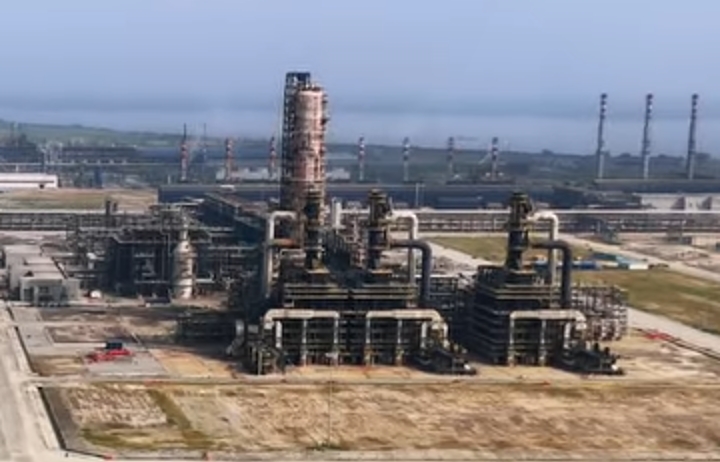
Image: Dangote Petroleum Refinery, Lagos .
The Manufacturers Association of Nigeria (MAN) urged the Federal Government and the petroleum industry regulators to disregard the recent prescription by the World Bank that Nigeria should open its borders to imported Premium Motor Spirit (PMS) to solve inflationary crisis.
In a position document on Friday April 17, titled ‘FUEL IMPORTATION PRESCRIPTION AS A RECIPE FOR DEINDUSTRIALISATION AND NATIONAL ECONOMIC RETROGRESSION,’ MAN, described the April 2026 Nigeria Development Update (NDU) by the World Bank, as ” structurally flawed, counterproductive, and highly detrimental to Nigeria’s industrialization agenda.”
Segun Ajayi – Kadir, its Director -General, noted,” While we welcome the Bretton Woods institution’s clarification that national energy security is paramount in today’s volatile global climate, we reiterate our fundamental objection to the initial premise that reinstating petrol import licenses is a viable, long-term strategy to avert an inflation spike. It is not, and should not be considered as an option.”
MAN emphasised that importation of PMS will undermine domestic refining capacity; contribute to the disruption of the foreign exchange market; disincentivize investment in and expansion of local refining, and truncate the relief that Nigerians have started to enjoy since the advent of Dangote Refinery and other local refineries.
Our Position
The World Bank’s report posited that the suspension of import licenses stifled competition, allowing domestic ex-depot prices to rise, thereby driving up inflation.
This analysis panders to short-term bias and does not take into account the following foundational macroeconomic realities of the Nigerian economy:
The FX Drain and the Major Driver of Inflation
Nigeria’s inflation is fundamentally cost-push and can be aggressively driven by exchange rate volatility.
Therefore, promoting PMS imports means returning to the era of fiercely competing for scarce foreign exchange (FX) to fund foreign refineries. Such depletion of FX depreciates the Naira further.
A weakened Naira spikes the cost of importing critical raw materials and machinery for domestic manufacturers, triggering a far bigger wave of inflation across all sectors of the economy than a temporary 12% differential in fuel pump prices.