








WHEN I was younger, bedtime storytelling was one of my favourite pastimes in my family. After the evening meal, my mother would usually gather us together for this special treat.
Of all the fables she told us, one that has remained indelibly etched in my memory to this day was Why the Giraffe Eats from Tall Trees.
The story portrayed the giraffe as a humble and considerate animal. Because of its long neck, it could reach the leaves and branches of tall trees, leaving the grasses and shorter vegetation for sheep and goats whose shorter necks could not reach the higher branches.
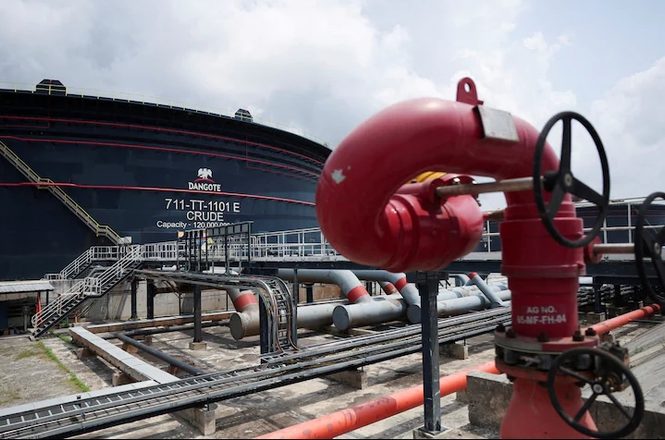
So, what is the point? Could the Dangote Petroleum Refinery be playing the giraffe in Nigeria’s downstream petroleum market—leaving marketers to supply the domestic market with imported Premium Motor Spirit (PMS), while it increasingly exports its refined products to other countries?Recent developments in the petroleum industry appear to lend some credence to this question.
The management of Dangote Petroleum Refinery recently attributed its increased export volumes to rising imports of petrol into Nigeria.
The refinery said the decision to focus more on exports should not be interpreted as a lack of commitment to the Nigerian market.
“Rather, exports are a prudent operational response to the realities of a market where imported products continue to compete with locally refined fuel despite the availability of sufficient domestic refining capacity,” the refinery said.Figures from the Nigerian Midstream and Downstream Petroleum Regulatory Authority (NMDPRA) appear to support the changing supply pattern.
According to the regulator’s recent report, Dangote Refinery’s supply of PMS to the domestic market fell by 21 per cent to 25.8 million litres per day in July, from 32.5 million litres per day in June.
The monthly factsheet showed that the refinery produced about 25.9 million litres of PMS per day in July and exported 3.4 million litres per day.
The July domestic supply figure was reportedly the lowest recorded by the refinery in 2026.At the same time, petrol imports rose by nine per cent to 19.7 million litres per day, from 18.1 million litres per day in June.
These figures raise an important question: Is Nigeria gradually returning to a situation where imported petrol is competing with locally refined PMS, even as Dangote Refinery has the capacity to supply a substantial portion of domestic demand?
Dangote Refinery has expressed concern about the continued issuance of import licences for petroleum products. It maintains that it has demonstrated sufficient capacity to meet, and even exceed, Nigeria’s domestic PMS requirements.
The refinery said that although it remains committed to Nigeria’s energy security and uninterrupted fuel availability, the continued inflow of imported PMS has created uncertainty around domestic demand forecasting and inventory management.
According to the refinery, it has consistently maintained sufficient inventories and reserved product volumes to guarantee steady supplies to the Nigerian market since commencing operations.That commitment, it said, has involved substantial investment in storage facilities, logistics and working capital to protect consumers from supply disruptions and market volatility.
Why Dangote Says It Is Exporting More
The refinery’s major concern appears to be the lack of transparency over the volume of imported petrol expected to enter the country.
Without reliable information on future import volumes, it argues, it becomes increasingly difficult to plan production and manage inventories efficiently. Maintaining large stocks of petrol that may not be absorbed by the domestic market also comes with significant storage and financing costs.
“As a responsible energy provider, we have always endeavoured to keep adequate reserves to satisfy local demand at all times,” the refinery said.
However, where significant quantities of imported PMS continue to enter the market through licences issued by the regulator, and there is limited visibility on future import volumes, the refinery says it becomes commercially unsustainable to hold excess inventory indefinitely.
Its argument is straightforward: when locally refined products cannot be absorbed by the domestic market because of competing imports, the surplus must be moved elsewhere. Hence, the increased exports.
The refinery insists that this does not mean Nigeria’s domestic market cannot be supplied. Rather, it says the exports are a response to market uncertainty created by competing imports.It also warned that if supply shortages eventually occur because of market distortions caused by excessive importation and the resulting difficulty in forecasting domestic demand, such shortages should not automatically be blamed on Dangote Refinery.
The company maintains that it remains ready and capable of meeting and exceeding Nigeria’s petroleum product requirements.
Dangote’s Transparency Concern Is Genuine—Expert
Oil and gas expert Dr Ayodele Oni believes Dangote Refinery’s concern over transparency is legitimate.According to him, Section 317 of the Petroleum Industry Act contemplates the issuance of import licences where there is a demonstrable shortfall.
But, he argued, a shortfall determination that is not published cannot easily be scrutinised.
“NMDPRA should publish, ex ante, the aggregate volume of import authorisations it has approved for each quarter and the shortfall assessment behind them.
That is a modest reform and it costs the regulator nothing,” he said.However, Oni cautioned against simply shutting out imports.He pointed to the performance of the country’s government-owned refineries, noting that NNPC’s three refineries produced nothing in July.
“A single plant supplying nearly the entire national market, with imports switched off, is a structural risk, not an achievement,” he argued.
He added that the Federal Competition and Consumer Protection Act exists to address such situations, stressing that regulatory policy should not be based on the assumption that a single refinery will never experience an unplanned outage.
According to him, the solution is structural: a transparent shortfall methodology, published quarterly import quotas, and the development of genuine second and third domestic refineries. “Everything else is noise,” he said.
Imports or Domestic Refining?
Another industry analyst and former Managing Director of 11PLC, formerly Mobil, Otunba Adetunji Oyebanji, believes Dangote Refinery is within its rights to export.
He argued that the government must retain the flexibility to import petroleum products whenever there is a potential shortfall.
“This is an internationally traded product,” he said, pointing out that even countries with substantial refining capacity, including the United States, continue to import petroleum products.His argument is that economics, rather than sentiment, ultimately determines where petroleum products are bought and sold.
“We heard that Dangote exported to America. Don’t they have refineries?” he asked rhetorically.
For him, pricing remains a major determinant.And therein lies the real issue.
The giraffe in my mother’s story was not merely tall; it was considerate. It reached the leaves that other animals could not reach and left the lower vegetation for them.
But Nigeria’s petroleum market is not a fable. Dangote Refinery is a commercial enterprise, not a charitable institution. It must make economically rational decisions, just as marketers and importers do.
The bigger question, therefore, is not whether Dangote Refinery should export. It is whether Nigeria’s petroleum regulatory framework is creating the right conditions for locally refined products to compete fairly, while ensuring that consumers are protected and the country is not exposed to the risks of relying too heavily on a single refinery.
If Dangote has the capacity to meet domestic demand but finds it more commercially sensible to export because imported PMS is competing with its products at home, then the problem may be bigger than Dangote. It may point to a regulatory and market-structure problem that requires urgent attention.
The government cannot simultaneously encourage domestic refining, allow substantial imports without clearly communicating the basis for them, and expect refiners to maintain costly inventories indefinitely.
There must be transparency. There must also be competition. And, most importantly, Nigeria needs more functioning refineries capable of supplying the domestic market.
Perhaps, then, the lesson from the giraffe is not that Dangote should leave the “grass” to the marketers. It is that the rules of the forest must be clear enough for every animal to know where it stands.