






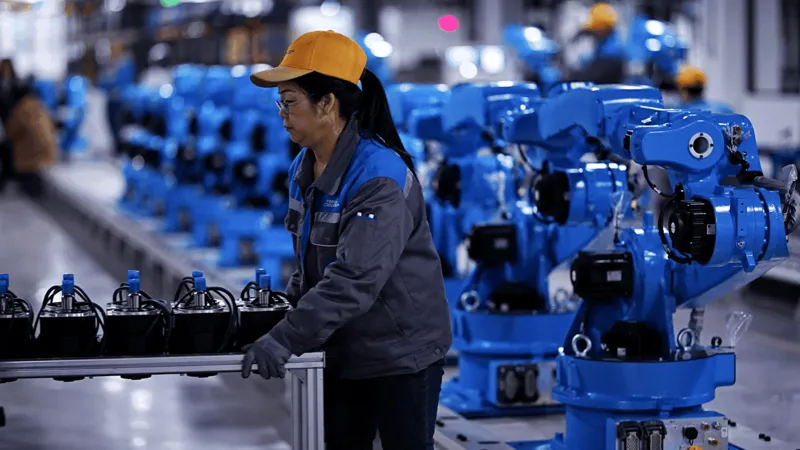
•Robots work alongside people in China’s factories
There are more than two million robots working in China’s factories – which is more than anywhere else – and they are continuing to scale up at extraordinary speed.
This is a front-row seat to what Xi calls China’s “new productive forces” – and how they could reshape the country.
A report by BBC also indicated that around 120 million people still work in China’s manufacturing sector.
According to BBC, the robotics transformation is a commitment that will surely change the world, much like the last time the Chinese economy underwent a massive transformation.
China is already shipping its robots across the globe: more than half of the world’s industrial robots are now made in China.
What is less clear is the impact of such sweeping automation in a country that sits at the heart of global manufacturing, trade and innovation. What does this mean for China’s human workforce, for instance? And how would we be able to truly measure the cost of this transformation in a regime that controls information so tightly?
The future of China’s workers is uncertain in the industrial revolution the world has been watching: gleaming solar grids, peak hours made noiseless by electric vehicles, machines that run faster than Usain Bolt.
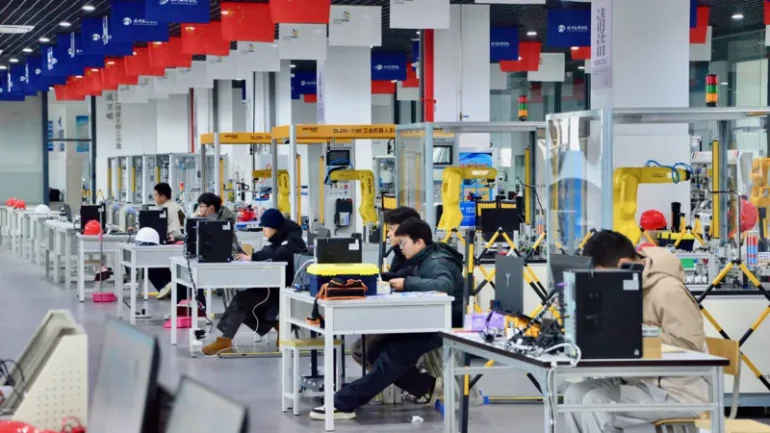
• Students learning robotics at the Hangzhou Technician Institute, one of many new vocational schools
Over the weekend, China hosted the second edition of the World Humanoid Games where robots boxed, sprinted and marched.
What is fuelling this spectacle is another, less visible revolution happening inside factories and classrooms.
The BBC has visited industrial sites where we have been shown robots that do not look human, or dance or leap on stage but weld, paint, lift, assemble and work around the clock without a break or benefits.
Some are designed to build more robots. We have also been inside academies where China is training the people who will work alongside its robotic workforce.
This is a front-row seat to what Xi calls China’s “new productive forces” – and how they could reshape the country.
On a factory floor in the southern city of Chengdu, the old and and the new are working side by side.
An assembly line of around 30 middle-aged men and women is screwing, drilling and polishing CRP Technology’s signature product: a robotic arm which performs various industrial tasks.
Also in the room are four young engineers crowded around a console, trying to crack the code for a prototype, a new robot that they hope will help build other robots.
Credit: BBC