








The Pan-African Manufacturers Association (PAMA) has questioned the use of Purchasing Managers’ Index (PMI) surveys published by Stanbic IBTC Bank/S&P Global and other financial institutions as indicators of manufacturing performance, arguing that they do not provide a complete picture of industrial production across Africa.
PAMA acknowledged the importance of the surveys in providing information on business conditions across major African economies but maintained that improvements in headline PMI readings should not automatically be interpreted as growth in manufacturing output.
Co-Interim Secretary-General of PAMA, Segun Ajayi-Kadir, said the indicators did not necessarily capture the actual performance of the manufacturing sector, particularly factory output, capacity utilisation, productivity and industrial investment.
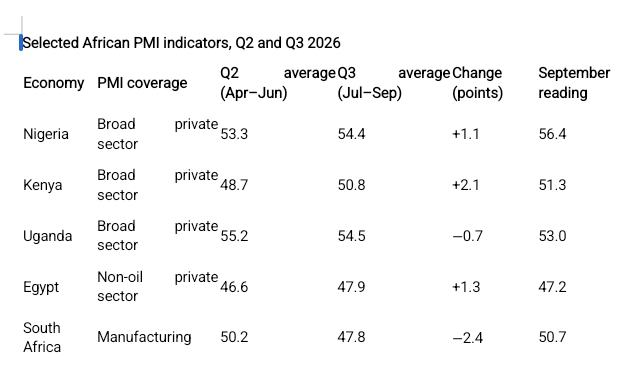
He cited September 2026 PMI data showing divergent business conditions across African economies.
Nigeria recorded stronger private-sector expansion, Kenya returned above the neutral threshold, while Uganda continued to expand at a slower pace.
Egypt’s non-oil private sector experienced renewed deterioration, while South Africa’s manufacturing PMI returned to expansion after three consecutive months below 50.
“The more important question is what lies behind these movements—and whether improvements in demand are translating into sustained production and stronger industrial performance.
“The distinction between improving demand and expanding production remains central to assessing manufacturing performance,” he said.
Nigeria’s PMI Records Stronger GrowthAjayi-Kadir specifically examined Nigeria’s Stanbic IBTC PMI, which increased from 54.3 in August to 56.4 in September, its highest level since February 2022.
The September report attributed the improvement to stronger new orders, 2026 by customer demand and the introduction of new products.
Business activity also increased at its fastest pace since February 2022, while new business rose for the eighth consecutive month.
The quarterly figures further reinforced the improvement, with Nigeria’s PMI averaging 54.4 in Q3 2026, compared with 53.3 in Q2, indicating an acceleration in the pace of improvement across the surveyed private sector.
However, PAMA argued that the Stanbic IBTC PMI is not a manufacturing-only indicator.
It maintained that the increase does not establish that factory output, capacity utilisation, manufacturing investment or productivity improved by a corresponding margin.
According to the association, these outcomes require confirmation through manufacturing-specific statistics.
MAN’s Confidence Index Offers Another Perspective
The Manufacturers Association of Nigeria’s (MAN) Manufacturers Confidence Index (MCCI) provides a complementary perspective on developments in the industrial sector.
The MCCI rose to 52.1 in Q2 2026 from 48.7 in Q1, indicating improved confidence among manufacturers.
The survey covered 400 manufacturing chief executives across 14 industrial zones and 10 sectoral groups.
PAMA noted that the two indices should not be interpreted as competing assessments because they measure different aspects of economic activity.
While the Stanbic PMI measures month-to-month changes in business conditions across the private sector, the MCCI assesses manufacturers’ perceptions of their operating environment and business outlook.
Consequently, their findings can differ without necessarily being inconsistent.
For manufacturers, access to finance, interest rates, electricity supply, foreign exchange availability, raw-material costs, infrastructure and logistics remain critical determinants of operating performance.
Although improved demand can support production, the extent to which manufacturers benefit depends on their ability to secure inputs, finance working capital and deliver products at competitive costs.
PAMA therefore argued that the September PMI establishes stronger momentum across the wider private sector but does not, by itself, demonstrate that the structural constraints affecting manufacturing competitiveness have eased.
A Quarter of Divergent Business Conditions
The association also cautioned against treating headline PMI figures across African countries as equivalent measures of industrial performance.
Ajayi-Kadir pointed out that the headline PMIs for Nigeria, Kenya and Uganda cover the wider private sector, while Egypt’s index measures the non-oil private sector.
South Africa’s Absa PMI, however, specifically tracks manufacturing activity.
“The indicators therefore provide different perspectives on business conditions and cannot be treated as equivalent measures of industrial output,” he said.